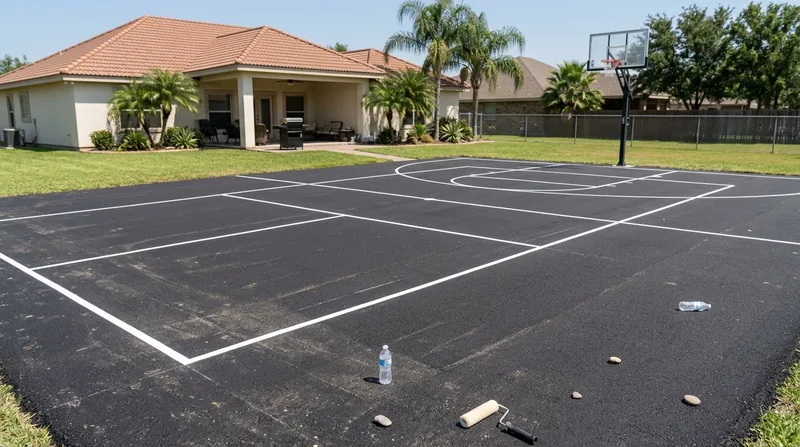




A backyard basketball court or tennis path in McAllen sits on delta clay that expands when wet and shrinks when dry, creating heave and settlement that cracks new asphalt in a single season if the base is not built right. The flat terrain and almost nonexistent natural drainage mean that sports court and path paving in McAllen requires a compacted aggregate base, proper pitch for water runoff, and hot mix asphalt laid to exact thickness so the court plays true through the hot, humid summers that dominate this region. We grade and compact a stable base, then finish with hot mix so the court stays flat and playable for years. Since 2010, we have built courts and paths across McAllen, Mission, Pharr, and the surrounding Rio Grande Valley, understanding the local soil and climate challenges that most paving crews overlook. A proper court is a long-term investment, and it starts with the base.
Why Proper Base Preparation Matters in McAllen's Climate
McAllen's alluvial soils are fine and silty in the north and loamy over clay in the south, and both types move significantly through wet and dry cycles. A court built on an uncompacted or poorly drained base will develop low spots, edge cracking, and surface heave within months. The base is the foundation of the entire court, and skipping it or rushing it is the single biggest reason courts fail early.
- We remove topsoil and vegetation to expose stable subgrade, then proof-roll the surface to identify soft spots.
- We bring in compacted aggregate base, typically four to six inches, and grade it to the proper slope for drainage.
- We finish with hot mix asphalt in two courses, binder and surface, laid and compacted to specification thickness.
- The court is sloped at roughly one quarter inch per foot so water sheds off and does not pool during tropical storms.
This approach holds courts flat through McAllen's seasonal wet spells and the intense summer heat that can soften inadequate asphalt. Our estimates include base depth and tonnage so you know exactly what you are paying for.
Local example: A residential tennis court in a Mission subdivision built on uncompacted clay developed a two-inch depression at the net line within eight months. Proper base work would have cost an extra $800 upfront and prevented a $3,500 resurfacing four years later.
Before you hire any contractor, verify with the City of McAllen Building Department whether your project requires a permit for work in the right-of-way or on property near utility lines. Grading and excavation always require a Texas 811 utility locate before work begins.
How We Build a Court That Plays Flat in McAllen
The process starts with a site visit to measure the area, inspect the soil, check drainage patterns, and identify utilities. We then grade the site, compact the base in lifts, and finish with asphalt laid to the thickness your court requires. The entire job is documented with written measurements and tonnage so there is no guesswork on either side.
- We locate utilities and mark the boundaries of the court area.
- We excavate and remove topsoil, then proof-roll the subgrade to confirm stability.
- We haul and spread compacted aggregate base to the specified depth and slope.
- We lay hot mix asphalt in two courses, binder first, then surface course, and compact each to density.
- We finish with a smooth, level surface ready for court markings or path use.
The whole job typically takes three to five days, depending on size and weather. New asphalt must cure for six to twelve months before sealcoating, so we advise against sealing immediately after installation.
Real example: A half-court in Edinburg, 1,200 square feet, took three days to grade, base, and pave. The base was six inches of compacted stone, and the court was pitched at one quarter inch per foot to a drainage swale. Cost was $9,200, including material, labor, and equipment.
For more detail on how we approach similar projects, see our work on parking lot paving in McAllen, which uses the same base-first methodology.
Court and Path Paving Methods
| Approach | Description | Best for |
|---|---|---|
| Full-Depth Asphalt Court | Compacted aggregate base four to six inches, hot mix asphalt two to three inches, pitched for drainage, finished smooth. | Basketball, tennis, or recreational courts where durability and flatness are critical. |
| Walking or Recreational Path | Compacted base three to four inches, hot mix surface one and a half to two inches, pitched lightly for water shedding. | Residential paths, garden walks, or low-traffic community routes where cost is a factor. |
| Recycled Asphalt or Millings Path | Compacted recycled asphalt or millings, three to four inches, with minimal finish work, lower initial cost. | Rural paths, ranch driveways, or temporary or secondary routes where budget is tight. |
| Tar and Chip Path | Compacted base, tar binder, and crushed stone or chip topping, one to two inches total, rustic appearance. | Rustic or historic properties, ranch lanes, or low-speed paths where a finished but informal look is acceptable. |
Each method is chosen based on traffic volume, drainage needs, budget, and the long-term use of the court or path. We help you select the right approach during the free estimate.
Sports Court and Path Paving Cost in McAllen: What to Expect
The cost of a court or path depends on the size of the area, the depth and type of base required, site access, and the final surface finish. A full-depth asphalt basketball court typically starts at $8,500 for a half-court on well-drained soil, but a full court, soft soil, or poor access can push that to $15,000 or more. A simple walking path may cost $3,000 to $5,000, while a professional-grade tennis court can reach $20,000 or higher.
The biggest cost drivers are base preparation (soft or clay-heavy soils require more stone and compaction work) and size. A one-thousand-square-foot court costs less per square foot than a five-hundred-square-foot area because the fixed costs are spread. Site access also matters: if we have to haul material by hand or use small equipment because of gates or tight spaces, labor and time rise.
We always provide a written estimate with the area measured, base depth specified, and total tonnage of asphalt included. This transparency helps you compare our quote fairly with others. To request a free estimate, call us at (956) 578-6392 or visit our pricing page for a full breakdown of court and path options.
What to Look for When Hiring a Sports Court Paving Contractor Near McAllen
The paving trade attracts both honest local shops and transient crews that show up with unsolicited offers, no written contract, and a demand for cash upfront. The strongest signal of a trustworthy contractor is a verifiable local address, local phone number, and a willingness to provide references and a detailed written estimate before any work starts. Ask any contractor you consider whether they are fully insured and invite them to provide a certificate of insurance.
- Request a written estimate that includes the area measured, base depth, asphalt thickness, and total tonnage.
- Ask for at least two references from court or path jobs completed in the past two years in McAllen or nearby.
- Verify that the contractor will pull any required permits and will have utilities located by Texas 811 before excavation begins.
- Check whether your HOA has architectural standards or material restrictions that apply to your court or path.
- Confirm that the contractor is fully insured and ask to see the certificate.
- Get at least two other estimates so you can compare scope, materials, and price fairly.
Honest contractors welcome these questions and will answer them directly. If a contractor refuses to provide a written estimate, pushes you to decide on the spot, or demands a large cash deposit before starting, walk away.
When you are ready to move forward, contact us at our contact page to schedule a free, no-obligation estimate. We have been serving McAllen and the Valley since 2010, and we are happy to answer any questions about your court or path project.
Sports Court & Path Paving in McAllen: Pricing Guide
| Service | Price | Details |
|---|---|---|
| Half-court basketball or tennis court | Starting at $8,500 | 1,200 square feet, four-inch base, two-inch asphalt, pitched for drainage, includes site prep and compaction |
| Full-court basketball or tennis court | Starting at $14,500 | 2,400 square feet, four-inch base, two-inch asphalt, pitched and finished smooth, cost rises with soft soil or poor access |
| Residential walking or recreational path | Starting at $3,500 | 500 to 800 square feet, three-inch base, one-and-a-half-inch asphalt, includes grading and compaction for drainage |
| Recycled asphalt or millings path | Starting at $1,800 | 500 to 800 square feet, compacted recycled material, lower cost, rustic appearance, suitable for ranch or rural use |
| Site-specific or complex job | On estimate | Large courts, poor drainage, clay subgrade, or limited access require on-site inspection before pricing |
| Free estimate | No charge | Includes site measurement, soil assessment, written proposal with tonnage, response within 24 hours, (956) 578-6392 |
Indicative pricing, the exact cost depends on square footage, finish, and site access. Free personalized estimate within 24h at (956) 578-6392.


